

In my ongoing exploration of interior design’s identity crisis, I’ve sought to uncover whether a viable resolution exists—one capable of rectifying the public’s misconceptions that tarnish the profession’s image and reinforce occupational stereotypes. To do so, I’ve turned to Social Identity Theory (SIT), a framework that explains how society’s perceptions of various professions are shaped and maintained (for more information on SIT read Are You in the INGROUP?). Through this lens, I’ve analyzed the existing information, aiming to identify strategies that could effectively dismantle the negative public image of interior design and address its embarrassing stereotypes (read more about this Does Interior Design Have an Image Problem?).

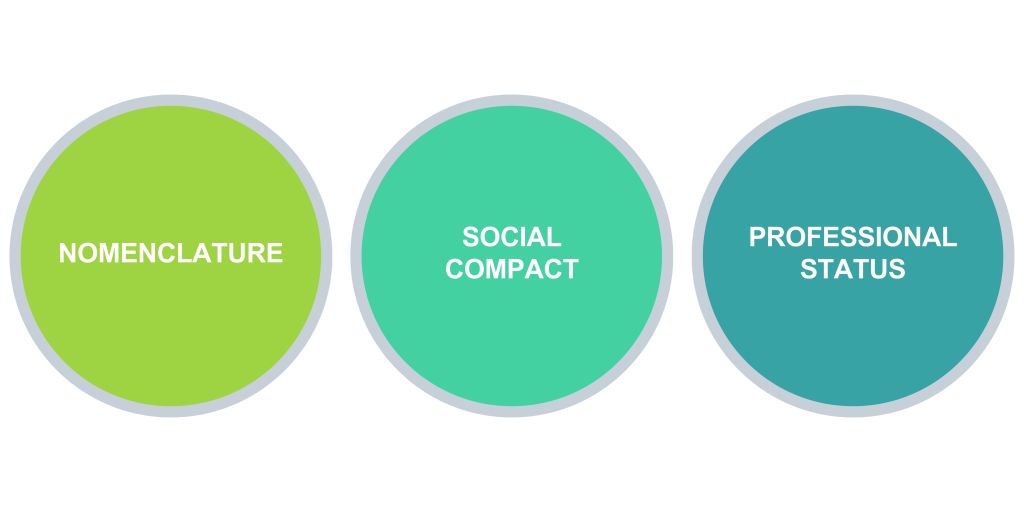
Through this analysis, three key strategies have emerged: nomenclature (a name change), social compact (an ethical commitment), and professionalization (attainment of recognized professional status). This article focuses on the social compact strategy, exploring its potential manifestations and its ability to elevate the public perception of interior design.
Understanding Social Identity and the Role of a Social Compact
Social Identity Theory suggests that when a social group faces an unfavorable public image, its members may strive for ‘social change’ (Spears, 2011; Tajfel & Turner, 2004). This means that practitioners may decide to fight to change the group’s negative image (or low status), or they may actively strive to make social changes that publicly enhance the group’s status. Interestingly, interior design appears to be considering this approach, as several scholars have advocated for the profession to explore its ethical obligation to society—its social compact to do good—and to communicate its significance and contributions in an attempt to improve public perception and reshape occupational stereotypes.
However, there is no consensus on what this social compact should look like. Some scholars argue for developing a distinct body of knowledge within interior design, differentiating it from architecture and severing its dependency on this older profession (Königk and Bakker, 2012). Others believe that interior design should embrace and emphasize its feminine aspects, suggesting that by leveraging its marginal position within the built environment, the profession could unlock its full potential (Havenhand, 2004; 2019). Additionally, there are calls for the profession to focus on socially responsible design, positioning this as its social obligation to society (Ndovela, 2021). Still, others advocate for incorporating interior design’s decorative aspects—such as its role in taste-making, decoration, and consumption—into its social compact (Khan and Königk, 2019).

The Interiors Declaration: A Social Compact in Practice?
It’s possible that interior design already has a social compact within its grasp. Königk (2015) suggests that the ‘Interiors Declaration,’ established at the DFIE global symposium in New York in February 2011, could serve as interior design’s social compact (find the declaration at: IFI-Interiors-Declaration). The declaration is described as a normative statement based on seven tenets: value, relevance, responsibility, culture, business, knowledge, and identity. Through this declaration, interior design has already defined its distinct area of practice and communicated its ethical obligations to society.
The Potential Impact of a Social Compact
So, why might a social compact be an effective strategy for improving interior design’s public image? By effectively communicating a social compact that resonates with the public, interior design could enhance its image and foster new, positive occupational stereotypes for its practitioners. However, achieving this requires consensus among practitioners on the chosen social compact’s attributes. These attributes would then form the new norms and prototypes of the discipline, eventually leading the public to associate them with the typical interior designer.
While this strategy shows promise, its true effectiveness hinges on persuading the media to adopt these new norms and prototypes in their portrayals of interior designers. A significant limitation, however, is that it does not protect the discipline’s title and practice. As a result, the profession may continue to face challenges from unqualified individuals marketing themselves as interior designers, potentially undermining the social compact’s impact.
Although a social compact is a viable strategy, its success may lie in a more blended approach. Therefore, I continue to explore other strategies, hoping that a resolution will emerge—one that embraces the idea of a social compact while also enhancing the public’s perception of this vital profession.
References:
Havenhand, L. K. 2004. A view from the margin: Interior design. Design Issues. 20(4): 32-42.
Havenhand, L. K. 2019. A re-view from the margin: interior design. Design Issues, 35(1): 67-72.
Jones, J. 2023. Exploring Professionalisation’s Ability to Resolve Interior Design’s Identity and Practice Frictions in South Africa. MTech. Durban University of Technology.
Khan, Z. and Königk, R. 2019. A thin veneer: Interior design’s social compact. In: Gray, B., Cook, S. C., Toffa, T. and Soudien, A. eds. Standing Items: critical pedagogies in South African art, design and architecture. University of Johannesburg: Jacana Media, 46-65.
Königk, R. and Bakker, K. A. 2012. Architecture’s other: an ontological reading of the abject relationship with interior design. Image & Text: A Journal for Design. 110-126.
Königk, R. 2015. Interior design’s occupational closure: an ethical opportunity. In: Proceedings of Proceedings of the 7th International DEFSA Design Education Conference. Midrand, South Africa. Midrand: Design Education Forum of Southern Africa, 182-190.
Ndovela, X. 2021. Social innovation: understanding selected Durban-based interior designers’ perceptions of socially responsible interior design. MTech. Durban University of Technology.
Seering, J., Ng, F., Yao, Z. and Kaufman. G. 2018. Applications of Social Identity Theory to Research and Design in Social Computing. Proceedings of the ACM on Human-Computer Interaction, 2(201): 1-34.
Tajfel, H. and Turner, J. C. 2004. The social identity theory of intergroup behaviour. Political Psychology, January: 276 – 293
 The True Profession of Interior Design
Leave a comment